
Service
Tax Planning
Keep more of what you have earned — by planning ahead, not filing later.
A tax preparer looks backward at the year that just ended. Tax planning looks forward. The main goal is tax diversification — having money in taxable, tax-deferred, and tax-free buckets so that in any given year you can choose where income comes from.
Tax planning for retirement is about lifetime taxes
Tax planning in retirement is less about this year's return and more about the total tax you pay over the rest of your life. A decision that saves a little tax today can cost much more later, and the reverse is true too. The work is to spread income across the years so more of it is taxed at lower rates.
We do not prepare returns or give tax advice. We build the strategy with you and coordinate with your CPA or tax preparer, who handles filing and formal tax advice, so the plan and the return agree.
The three tax buckets
Almost every retirement account falls into one of three tax treatments. Having money in all three gives you choices each year about where your income comes from.
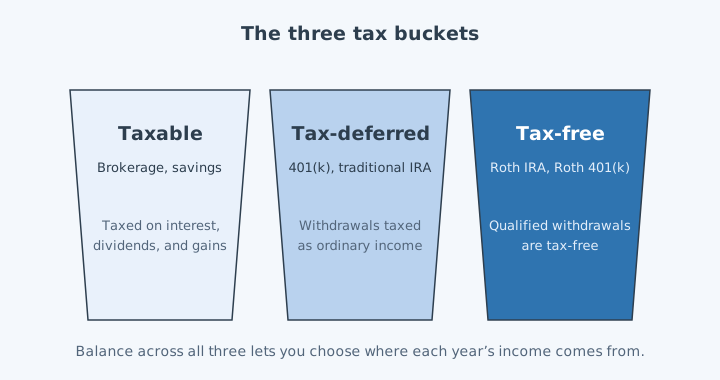
- Taxable: brokerage and savings accounts. You pay tax on interest and dividends each year, and on gains when you sell, often at lower capital gains rates.
- Tax-deferred: traditional 401(k)s and IRAs. Contributions reduced your taxes when you made them; every withdrawal is taxed as ordinary income.
- Tax-free: Roth IRAs and Roth 401(k)s. Qualified withdrawals are tax-free, and Roth IRAs have no required distributions for the original owner.
Many people arrive with nearly everything in the tax-deferred bucket. Our article on tax diversification explains why that can create a large tax bill later, and how to rebalance the buckets over time.
Roth conversions in the low-income years
The years between retiring and starting Social Security or required distributions are often your lowest-income years. Converting part of a traditional IRA to a Roth IRA in those years means paying tax on the converted amount now, at a known and often lower rate, so that money can grow tax-free afterward.
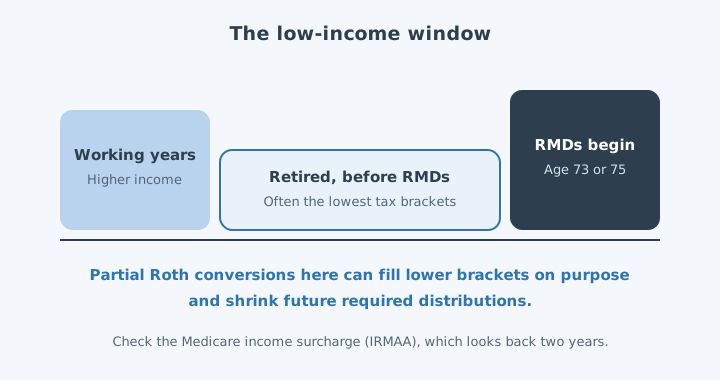
Conversions are a math question, not a rule of thumb. We model the bracket you would fill, the effect on the Medicare premium surcharge (which is based on income from two years earlier), and the break-even point, and we check the numbers with your CPA before you act.
Required minimum distributions
Once you reach the required age, the IRS requires a minimum withdrawal from tax-deferred accounts every year. Required minimum distributions begin at 73 for people born from 1951 through 1959 and at 75 for people born in 1960 or later. Missing one triggers an excise tax of 25 percent of the shortfall, reduced to 10 percent if corrected promptly. The IRS explains the rules in detail on its required minimum distributions page.
Planning in the years beforehand keeps those distributions from pushing you into a higher bracket or raising your Medicare premiums. If you give to charity, qualified charitable distributions from an IRA after age 70½ can count toward your required distribution without being added to your taxable income, up to an annual limit set by the IRS.
What Florida residents still need to plan for
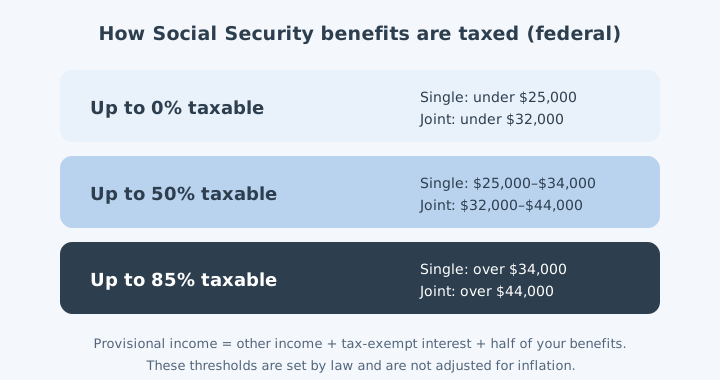
Florida has no state income tax, which is a real advantage for Jacksonville retirees. Federal income tax still applies, including on up to 85 percent of Social Security benefits once your other income passes certain thresholds. Capital gains, the Medicare income surcharge, and the taxes your heirs will face on inherited retirement accounts all still belong in the plan.
Tax planning works best as part of one coordinated plan with your income planning and legacy planning, and your first visit is complimentary.
Who this is for
You might recognise yourself here
Almost everything you have is in a 401(k) or traditional IRA
That is one bucket, and every dollar that comes out of it is taxed as ordinary income. Required minimum distributions can push you into a bracket you did not choose.
You are in a low-income window before RMDs begin
The years between retiring and required distributions are often the lowest-tax years of your life — and the best window for conversions.
You are carrying large unrealized gains
A concentrated stock position or an old taxable account can be unwound gradually and deliberately instead of all at once.
What we do
How this works in practice
No jargon, no black box. Here is the actual work.
-
Assess the whole tax picture
Income taxes now, capital gains on the way, and estate taxes later — including how Florida's lack of a state income tax changes the math.
-
Build tax diversification
We work toward a balance across taxable, tax-deferred, and tax-free accounts so that future you has options instead of one forced answer.
-
Evaluate Roth conversions
Converting in low-income years can lower lifetime taxes and shrink future required distributions. We model the bracket, the Medicare premium surcharge, and the break-even.
-
Sequence withdrawals
Which account you tap first — and in what proportion — is one of the highest-value decisions in retirement.
-
Coordinate with your CPA
We do not prepare returns or give tax advice. We build the strategy and then get your tax professional in the room so the plan and the return agree.
How it fits your bigger plan
One piece of a single plan
Tax planning is the quiet multiplier. It does not change what your investments earn, but it changes what you keep — and it touches income planning, legacy planning, and Medicare premiums all at once. That is exactly why it belongs inside one plan rather than at the end of one.
See the comprehensive plan
Your planner
Jason French, MBA
Founder and lead advisor of French Capital Management. A disabled combat veteran and former Merrill Lynch and Edward Jones advisor, Jason now works as an independent fiduciary for families in Jacksonville and across Northeast Florida.
Meet JasonQuestions
Common questions about Tax Planning
Do you do my taxes?
No. French Capital Management does not provide legal or tax advice and does not prepare returns. We build the strategy and work alongside your CPA or attorney so everyone is looking at the same plan.
Is a Roth conversion right for me?
Sometimes. It depends on your bracket today versus the bracket you expect later, whether you can pay the tax from outside the account, how it affects Medicare premiums, and what you want to leave behind. It is a math question, and we run it.
What are required minimum distributions?
Once you reach the required age, the IRS makes you withdraw a minimum amount from tax-deferred accounts each year whether you need the money or not. Planning in the years beforehand is how you keep those distributions from pushing you into a higher bracket.
I live in Florida — does state tax planning still matter?
Florida has no state income tax, which helps. Federal taxes, capital gains, Medicare premium surcharges, and estate taxes still apply, and a move across state lines later can change everything.
When is the best time to do tax planning?
Before the tax year ends, and ideally in the years just before and after you retire. Once December 31 passes, a tax return can only report what happened; tax planning is how you decide what happens.
Will you work with my CPA?
Yes, and we prefer to. We build the strategy and share it with your CPA or tax preparer, who handles the return and formal tax advice, so everyone is working from the same plan.
Related
Other pieces of the plan
Healthcare Planning
Medicare decisions, coverage before 65, and a realistic plan for long-term care costs.
Legacy & Estate Planning
Coordinating with your attorney to protect what you have built and pass it on cleanly.
Comprehensive Planning
Many pieces, one plan — the holistic engagement that ties every part of your financial life together.
Let's talk about your plan
A relaxed, no-pressure conversation about your goals. Free, about 30 minutes, and you will leave with something useful whether or not we work together.
Veteran-owned · Independent fiduciary · Jacksonville, Florida