
Service
Income Planning
Turn what you have saved into a paycheck that lasts as long as you do.
The hardest switch in retirement is the one from saving to spending. For thirty or forty years a paycheck arrived on its own. Income planning is how we replace it — deliberately, in the right order, from the right accounts.
What income planning means in retirement
Income planning is the work of turning a lifetime of savings into a reliable monthly paycheck. While you are working, income arrives on its own and the job is to save. In retirement the direction reverses: you decide how much to take, from which account, in what order, and how to keep it going for thirty years or more.
Good retirement income planning answers three questions in plain numbers: how much you actually spend, where each dollar will come from, and what happens to the household if markets fall, inflation runs hot, or one spouse passes away first.
Start with the spending you cannot skip
We separate your budget into essential spending (housing, food, insurance, healthcare, taxes) and flexible spending (travel, gifts, hobbies, the new roof you would like but can delay). The goal is to cover the essentials with income you can count on, and fund the flexible part from your investments.
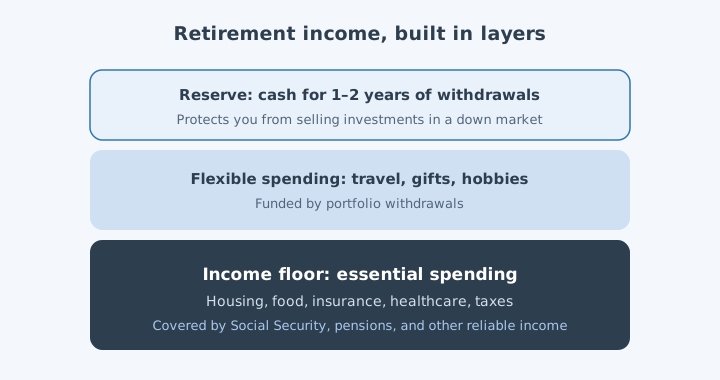
That structure matters when markets drop. If your groceries and property taxes are already covered by Social Security and a pension, a bad year in the stock market changes your travel plans — not your ability to pay the bills.
Social Security timing: the biggest income planning decision
For most households, Social Security is the largest source of lifetime income, and the claiming age is permanent. A few rules shape the decision:
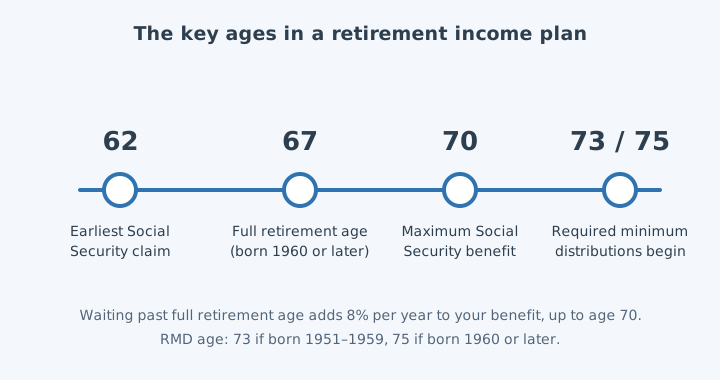
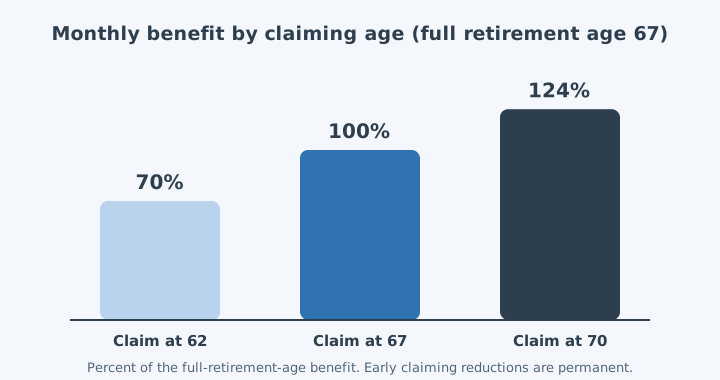
- You can claim as early as 62, but the monthly benefit is permanently reduced. For anyone born in 1960 or later, full retirement age is 67.
- For every year you wait past full retirement age, up to age 70, your benefit grows by 8 percent.
- When one spouse dies, the survivor keeps the larger of the two benefits. That makes the higher earner's claiming age a decision about the survivor's income, not just their own.
We model your claiming options using your actual earnings record. Your current estimate is available in your my Social Security account at SSA.gov, and it is one of the first documents we ask for.
Building a withdrawal order that lowers lifetime taxes
Most retirees hold money in three kinds of accounts: taxable brokerage accounts, tax-deferred accounts such as a 401(k) or traditional IRA, and tax-free Roth accounts. The order and proportion in which you draw from them changes how much tax you pay over your whole retirement.
Required minimum distributions from tax-deferred accounts begin at age 73 for people born from 1951 through 1959, and at 75 for people born in 1960 or later. The years between retiring and those distributions are often a low-tax window we can use on purpose, for example with partial Roth conversions. We coordinate this with our tax planning work so the income plan and the tax plan agree.
Living in Jacksonville helps: Florida has no state income tax, so the planning centers on federal brackets, capital gains, and the Medicare premium surcharge that rises with income.
Pensions, military retirement, and survivor elections
If you have a pension, the election you make at retirement is usually irreversible. A single-life payment is larger but stops at your death; a joint-and-survivor option pays less but continues for your spouse. Some plans also offer a lump sum. We compare each option side by side, including what a lump sum would need to earn to match the guaranteed payment.
Military retirees face a similar choice with the Survivor Benefit Plan, and veterans often have VA disability compensation, which is not taxable. As a disabled combat veteran himself, Jason builds these pieces into the income plan rather than treating them as an afterthought.
Stress-testing your retirement income plan
A plan that only works in average years is not a plan. We test yours against a weak market in the first years of retirement, higher inflation, a long life, and the loss of one household income. Then we set simple guardrails: when to hold spending steady, when you can give yourself a raise, and when a small adjustment protects the long run.
Income planning in Jacksonville with a fiduciary
We meet at our office in the Mandarin area of south Jacksonville or by video, whichever suits you. As a fiduciary we are required to put your interests first, and for investment management we are fee-only, so the recommendation is about your paycheck rather than a product. Your first visit is complimentary, and you can bring a single question — a pension election or a claiming decision — rather than your whole financial life.
Who this is for
You might recognise yourself here
You are five years out and doing the math in your head
You have a number in mind but no one has ever shown you, month by month, where the money actually comes from.
You are choosing when to claim Social Security
The difference between claiming at 62, at full retirement age, or at 70 can be six figures over a lifetime — and it is not the same answer for everyone.
You have a pension decision in front of you
Single life, joint and survivor, or lump sum. It is usually irreversible, and it deserves more than a coin flip.
What we do
How this works in practice
No jargon, no black box. Here is the actual work.
-
Map what comes in and what goes out
We start with your real expenses — the fixed ones, the fun ones, and the ones that only show up once a year — and compare them against every income source you already have.
-
Model Social Security timing
We look at your benefit at different claiming ages, how a spouse's benefit interacts with yours, and what happens to the survivor if one of you passes first.
-
Work through the pension election
We compare the survivor options side by side, including what a lump sum would realistically need to earn to beat the guaranteed payment.
-
Build a withdrawal order
Which account you draw from first changes your tax bill for the rest of your life. We sequence taxable, tax-deferred, and tax-free withdrawals on purpose.
-
Stress-test it
We check the plan against inflation, a bad market in your first years of retirement, and the loss of one household income.
How it fits your bigger plan
One piece of a single plan
Income is the foundation the rest of the plan stands on. Once we know what the paycheck looks like, the investment mix has a job to do, the tax plan has a target to work against, and healthcare costs stop being a guess. That is what makes it part of one plan instead of six separate conversations.
See the comprehensive plan
Your planner
Jason French, MBA
Founder and lead advisor of French Capital Management. A disabled combat veteran and former Merrill Lynch and Edward Jones advisor, Jason now works as an independent fiduciary for families in Jacksonville and across Northeast Florida.
Meet JasonQuestions
Common questions about Income Planning
When should I claim Social Security?
It depends on your health, your spouse's benefit, whether you are still working, and how much of your income needs to be guaranteed. Claiming early locks in a permanently smaller benefit — including for a surviving spouse — while waiting until 70 raises it. We run your actual numbers rather than using a rule of thumb.
How much can I safely withdraw each year?
The old answer was four percent. The honest answer is that it changes with your age, your mix of investments, how flexible your spending is, and how much of your baseline is already covered by Social Security or a pension. We give you a starting rate and a plan for adjusting it.
What happens to our income if one of us dies?
Usually the household keeps the larger of the two Social Security benefits and loses the smaller one, and a pension may drop or stop entirely. We plan for that in advance so the survivor is not making decisions in the worst week of their life.
Do I need to move everything to you to get an income plan?
No. The first visit is a conversation, not a transfer of accounts. Plenty of people come in to get a second opinion on a pension election or a claiming decision, and that is a perfectly good reason to sit down.
When should I start income planning for retirement?
Ideally five to ten years before you stop working. Many of the most valuable income planning decisions, such as Social Security timing, pension elections, and Roth conversions in low-income years, work best with time to plan. That said, it is never too late to organize the income you have.
Do you recommend annuities?
Sometimes, and only when guaranteed lifetime income solves a real gap in your plan. Many people do not need one. Annuities are insurance products: if you buy one through us, the insurance company pays a commission, which we disclose before you decide. You are never obligated to buy insurance from us.
Related
Other pieces of the plan
Investment Planning
Risk-based, customized portfolios using independent, cost-efficient funds — not a house list.
Tax Planning
Tax diversification designed to minimize income, capital-gains, and estate taxes over your lifetime.
Healthcare Planning
Medicare decisions, coverage before 65, and a realistic plan for long-term care costs.
Let's talk about your plan
A relaxed, no-pressure conversation about your goals. Free, about 30 minutes, and you will leave with something useful whether or not we work together.
Veteran-owned · Independent fiduciary · Jacksonville, Florida